
• Skip to main content
presidio-group-logo
  • About
  • Services
    • Finance Consulting
    • Vehicle & Equipment Finance
    • Financial Services
    • Home Ownership
    • Confidence to Grow
    • Property Consulting
    • Services for professional advisers
  • Team
  • News
  • Contact
×
  • About
  • Services
    • Finance Consulting
    • Vehicle & Equipment Finance
    • Financial Services
    • Home Ownership
    • Confidence to Grow
    • Property Consulting
    • Services for professional advisers
  • Team
  • News
  • Contact
07 3391 7055
Need vehicle or equipment finance?

Jacqueline Barton

Property Market Update – June 2024

Jacqueline Barton · Jul 4, 2024 ·

Winter is here, and for savvy property hunters, it could be a cool time to snap up a bargain.

The benefits of buying in winter are that there’s often less competition amongst buyers and you get to see the property during a less flattering time of year, so you know what you’re in for.

The property market continues to perform strongly, with the latest CoreLogic figures revealing house prices increased in all capital cities except Hobart and Darwin in May. Perth experienced the largest capital growth during the month at 2%.

If a winter property purchase is on the cards, chat to us about getting your finance pre-approved today.

Interest rate news

The Reserve Bank of Australia (RBA) Board decided to keep the cash rate on hold at 4.35 per cent at its latest meeting.

Inflation is continuing to ease, but is falling more gradually than previously expected, according to the RBA.

“Inflation has fallen substantially since its peak in 2022, as higher interest rates have been working to bring aggregate demand and supply closer towards balance,” the RBA Board said in its monetary statement.

“But the pace of decline has slowed in the most recent data, with inflation still some way above the midpoint of the 2–3 per cent target range.

“Over the year to April, the monthly CPI indicator rose by 3.6 per cent in headline terms, and by 4.1 per cent excluding volatile items and holiday travel, which was similar to its pace in December 2023.”

It would appear homeowners may have to put any hopes for a cash rate cut on ice for the time being.

“The Board expects that it will be some time yet before inflation is sustainably in the target range,” the RBA Board said.

“The path of interest rates that will best ensure that inflation returns to target in a reasonable timeframe remains uncertain and the Board is not ruling anything in or out.”

The Board meets next on August 5-6. To explore your home loan options, get in touch today.

Home value movements

National housing values rose 0.8% in May, the 16th consecutive month of growth and the largest monthly gain since last October.

Perth topped the growth charts with a rise of 2% in May, followed by Adelaide at 1.8% and Brisbane up 1.4%. The other capital cities experienced milder home value changes.

CoreLogic research director Tim Lawless said extremely low levels of available supply across the strongest markets provided the best explanation for the difference in growth rates.

“The number of properties available for sale in Perth and Adelaide remain more than -40% below the five-year average for this time of the year, while Brisbane listings are -34% below average,” Mr Lawless said.

“Inventory levels in these markets remain well below average despite vendor activity lifting relative to this time last year.

“Fresh listings are being absorbed rapidly by market demand, keeping stock levels low and upwards pressure on prices.”

On the other hand, listings across Hobart are tracking 41% above the five-year average because of lower demand, with home sales -6.4% below the previous five-year average over the rolling quarter.

Meanwhile, growth in regional Australia’s housing values and rents continues to pick up pace, with both reaching new record highs.
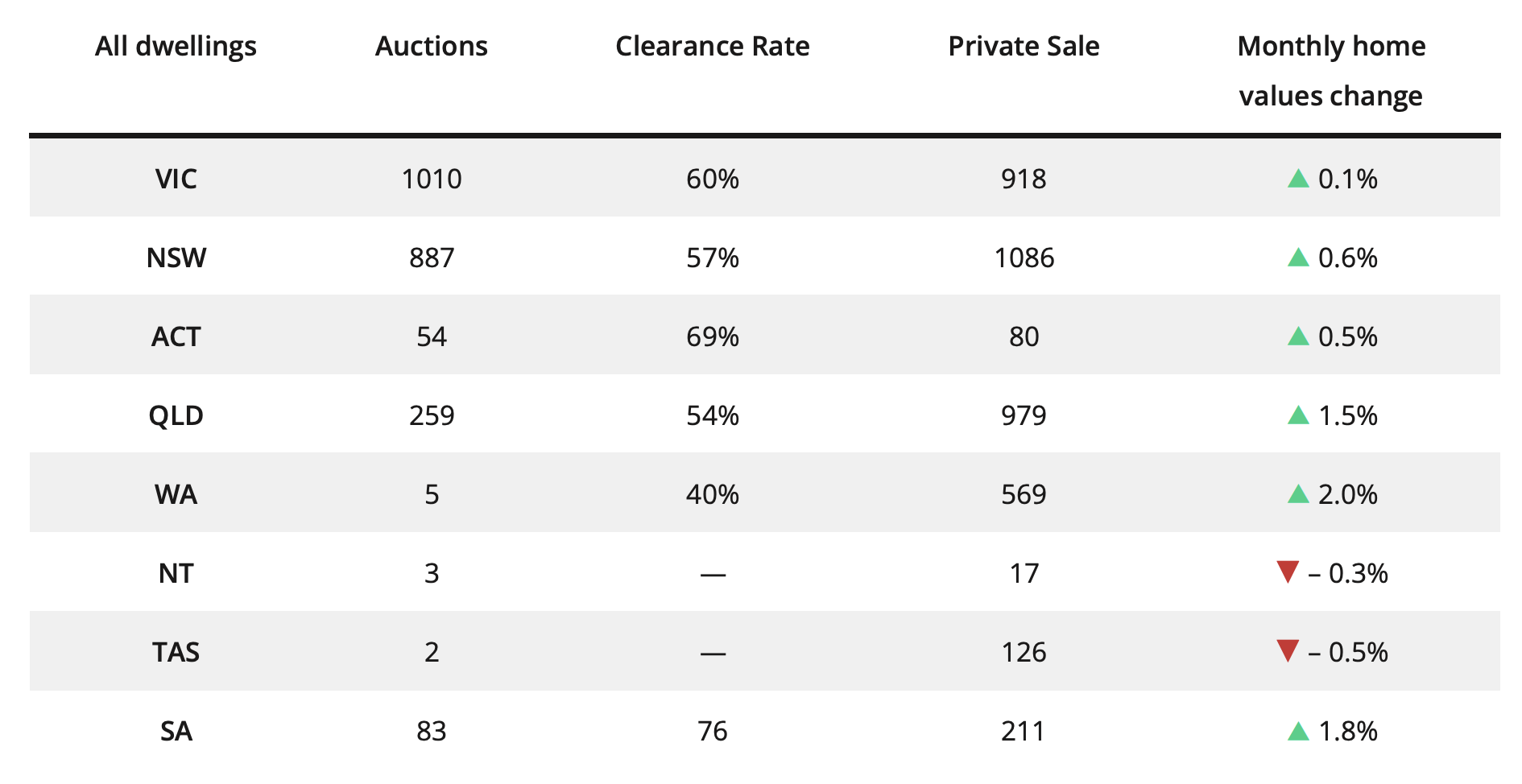
* Monthly Home Values figures as of 31 May 2024

* Australian auction results, clearance rates and recent sales for the week ending 16 June 2024

* The clearance rate is preliminary and current as of 5:30 am, 17 June 2024

Looking to buy this winter? The first step is to chat to us about how much you can borrow and get your finance pre-approved. That way, you’ll be ready to make an offer or bid at auction when you find the right property for your needs.

Let’s chat about your finance options. Please contact us for assistance.

5 ideas to boost your property value

Jacqueline Barton · Jun 19, 2024 ·

There are many reasons to consider renovating, from making your property more liveable to driving up its market value and increasing the rental income if it’s an investment.

So, which renovations should you consider when looking to generate a return on investment? Here’s some inspiration.

The kitchen update

The kitchen is often the focal point of a property, and it gets a lot of use, so it’s little wonder kitchen updates often drive up resale value. Consider giving your kitchen a facelift by removing walls and making it open plan, adding islands or storage areas, or upgrading benchtops, splashbacks, cabinetry, and appliances.

While it may be tempting to completely rearrange your kitchen layout, relocating plumbing or electrical work can significantly add to your overall costs. Keeping the cabinets in place and simply replacing or resurfacing the doors can offer substantial savings.

Cost guide: Anywhere from $10,000 to $45,000+.

The bathroom remodel

After the kitchen, bathrooms are possibly the next most popular area of the home to renovate. Buyers and tenants love fresh, modern bathrooms, so it’s worth considering as part of your renovation plans.

You can start simple by replacing old grout and upgrading fixtures such as taps, sinks, showerheads, and mirrors. Re-tiling or adding new baths and showers will obviously cost more but may pay off in the long run. If you’re looking to get fancy, consider adding heated towel bars and flooring.

Cost guide: Anywhere from $8,000 to $35,000.

The curb appeal boost

First impressions count, and when it comes to prospective buyers or tenants, you want your property to make a good impact. Landscaping can help boost the property’s curb appeal and add value.

If it’s an investment property, low-maintenance plants are a smart choice. You may also consider adding lighting and updating the fencing to give your property that ‘wow’ factor.

Cost guide: It’s recommended to avoid spending more than 5% to 10% of the property’s value on landscaping. The national median property value is $779,819, so in this instance, budget for between $39,000 and $78,000.

Landscaping estimates vary widely, so make sure to consider multiple quotes before contracting a landscaper.

The granny flat build

If you have space for it, why not consider building a granny flat to increase your property’s value? Many homeowners are turning to granny flats to generate extra income.

According to CoreLogic, adding a granny flat could boost home values by 30 per cent and add around 27 per cent to rental income.

Be sure to get in touch with your local council to find out about planning permissions and anything else that’s required. It’s also a good idea to speak to your accountant about the tax implications.

Cost guide: The average cost to build a granny flat is $80,000 to $160,000.

The expansion

If your house is suitable, you could consider expanding the footprint of your home.

When you decide to expand your home, you generally have two options: build outwards or upwards. Many homeowners hesitate to add a second storey, fearing that the costs will be significantly higher than those of a ground-floor extension.

To reach a decision, you’ll need to weigh up your budget, your circumstances, the block of land, and your existing home to work out which option suits you. It’s estimated that building up will cost about 30% more than building out but could add between 30 to 60% to the value of your home.

Cost guide: Roughly $1,850 to $3,000 per square metre depending on the “degree of difficulty”.

Like to explore your finance options?

If you’ve paid down your mortgage somewhat or your property’s value has increased, you may be able to access your equity to get your reno off the ground. Otherwise, we can run you through other finance options available that could be available to you.

Please contact us for assistance.

*Costs and prices in this article are indicative and should only be used as a guide. They also vary locally and are subject to market forces.

The tiny house movement

Jacqueline Barton · Jun 7, 2024 ·

As housing prices continue to soar, many people are increasingly considering whether to buy a tiny home to live in or as a holiday home.

The tiny house movement has been around for some time now, but despite its growing popularity, legislation is yet to catch up. This has left many confused about what’s legal, and what’s not.

If you’re interested in joining the tiny home movement, here are a few things you need to consider before buying.

Why people buy tiny homes

  • The price factor – tiny homes vary in price according to the design and materials. DIY kits can start from $10,000 to $20,000 for a simple design, while custom builds can be closer to $200,000.
  • Environmental factors – if the idea of living simply and reducing your environmental footprint appeals, a tiny home could work for you. You may even consider living of grid (with a rainwater tank, solar panels and a compost toilet, for example).
  • Reduced expenses – living in a tiny home reduces running costs for things like water and electricity. Handy in this day and age.
  • Flexibility – tiny homes ofer a diferent way of living, with the freedom to relocate in future (if your tiny house is on wheels).
  • For investment purposes – some people rent out their tiny houses to generate additional income streams.

What are the regulations?

Things can get a bit murky when you dive into the regulations around tiny houses. The rules vary depending on location, and many councils don’t even have clear tiny house regulations, making it tricky for aspiring tiny homeowners.

There are two types of tiny homes – those on a foundation, and those on a trailer on wheels.

Tiny houses on a foundation are considered fixed dwellings and are usually treated like any other building, in the sense that you need council approval and building permits.

To get around these requirements, many people keep their tiny homes on wheels. Councils often apply the same rules to tiny houses as they do to caravans. The trailers that tiny houses are constructed on also need to comply with
certain standards.

In most states, there are limitations on how long you can permanently live in tiny homes on private land. Some councils are relaxing these rules.

Bottom line: Contact your state/territory government and local council before buying a tiny house to see what the latest regulations are that apply to you. You’ll also need to look into the maximum size limits of your tiny home.

You can find more information, including local laws and state regulations, on the Australian Tiny House Association website.

What about finance?

If you opt for a tiny home on wheels (and it’s legally classified as a caravan), applying for a home loan won’t work. But that doesn’t mean your tiny home dream is dead in the water.

We may be able to line you up with a personal loan, for example, or in some instances, you may be able to use your existing equity to fund the build. Speak to us and we’ll run you through your finance options.

If you need finance to purchase land to park your tiny home on, or for the vehicle to tow it, we can also help with that.

If you’re interested in joining the tiny home movement, get in touch and let’s put the wheels in motion.

All information is intended to be a guide only and should not be considered legal advice, it’s always best to contact your state and local councils before purchasing a tiny house.

Property Market Update: May 2024

Jacqueline Barton · May 23, 2024 ·

The weather may be cooling down as winter approaches, but the property market continues to sizzle.

The latest CoreLogic figures revealed house prices rose for the 15 month in a row across the country in April. The national median dwelling value is now $779,819.

Sydney remains the most expensive place to buy, with the median now at $1.4 million, while Melbourne was the only city to see a slight fall in prices in April. Perth had the largest gains of 2.0 per cent.

If you’re considering a winter property purchase and want to get your property dream on track, chat with us about getting your finance pre-approved today.

Interest rate news

The Reserve Bank of Australia (RBA) kept the cash rate on hold at 4.35 per cent at its latest meeting.

And while the news is positive for struggling homeowners, many are wondering how long the reprieve will last as the RBA continues to battle inflation.

Michele Bullock, the RBA governor, has not ruled out future increases to the cash rate. She stated that the war against inflation “isn’t yet won” and described the risks to its outlook remain “finely balanced”.

While some economists have predicted further rate hikes are a near-term possibility, with potential cuts expected to occur at a slower pace, the latest Roy Morgan data reveals a stark reality: more than 1.5 million mortgage holders were at risk of mortgage stress in March 2024.

If you’re one of them, get in touch and we will run you through your finance options, including whether there’s a more competitive home loan available to you.

The RBA board meets next on June 17-18.

Home value movements

National housing values rose 0.6% in April, with low supply continuing to drive up prices.

Perth topped the growth charts with a rise of 2% in April, followed by Adelaide at 1.3% and Brisbane at 0.9%.

Meanwhile, Melbourne property prices fell -0.1%.

“We aren’t seeing any signs of heat coming out of the Perth housing market just yet, in fact the quarterly pace of growth, at 6.0%, is approaching the cyclical highs seen during the pandemic when interest rates were at rock bottom,” CoreLogic research director Tim Lawless said.

“On the other hand, we are seeing the pace of gains slow across the Brisbane market, easing below the 1% mark to 0.9% in April for the first time in 12 months.

“Affordability pressures may be impacting the pace of growth across the city, following a nearly $300,000 increase in values since the onset of COVID in March 2020, the largest dollar value increase of any capital.”

Regional markets showed a slightly stronger quarterly growth rate over the past five months compared to their capital city counterparts.

Regional WA (+5.3%) led the way, followed by Regional SA (3.9%) and Regional Queensland (+3.2%). Regional Victoria (-0.1%) was the only rest-of-state market to record a decline in values over the rolling quarter.

* Monthly Home Values figures as of 30 April 2024

* Australian auction results, clearance rates and recent sales for the week ending 12 May 2024

* The clearance rate is preliminary and current as of 3:00 pm, 14 May 2024

Whether you’re planning an exciting property purchase, or you’re looking to refinance your loan, we’re here. Please contact us for assistance to talk through your finance needs.

When should you refinance an investment property?

Jacqueline Barton · May 21, 2024 ·

With hundreds of thousands of mortgages rolling off fixed rate terms and property owners facing the mortgage cliff as they jump to higher variable repayments, a lot of investors are wondering whether now is a good time to refinance.

Reserve Bank of Australia (RBA) data shows there will be 450,000 mortgages coming off fixed terms in 2024.

The cash rate has been on hold since November at 4.35%, but many economists now expect the RBA’s next move to be a cash rate cut – likely a 25-basis point easing in the cash rate at the RBA’s September 23-24 board meeting.

So, should you hold and wait to see what the RBA does, or should you shop around for a more competitive loan now?

It all depends on your current mortgage rate, your financial goals and whether the benefit of refinancing outweighs the cost involved.

However, at the very least, it always pays to explore your options, especially when it comes to something as costly as your investment property.

Why it pays to consider refinancing

Refinancing your loan can allow you to access the equity in your property. Equity is the proportion of the property you own.

Say the property is worth $800,000 and you owe $200,000 to the bank. You have $600,000 in equity.

Savvy property investors use their equity for a variety of purposes:

  • To renovate and add value to their investment property,
  • As a deposit for their next investment property, or
  • To fund their lifestyle and living expenses.

Another popular reason to refinance is to secure a more competitive interest rate or a loan that better suits your needs.

There may also be loan features that could improve your interest savings or cash flow like offset accounts and redraw facilities.

Key considerations before refinancing

1) How much equity do you have?

Generally, the right time to refinance your investment property is when the equity has grown sufficiently to take the next step in your investment strategy or to fund your renovation plans.

To get an idea of the value of your property and how much equity you have, you can:

  • Ask us for a free property profile report with the latest market insights.
  • Talk to local real estate agents for a market value estimate.
  • Pay for a professional property valuation (a formal valuation will likely be required by the lender before they will allow you to refinance).

2) What is the cost of refinancing?

Switching lenders and refinancing your investment loan can help you achieve your goals, but there are costs involved.

These may include break fees or discharge fees, establishment fees for your new investment loan, and valuation fees.

Speak to us and we’ll run you through the costs and help you decide whether refinancing is worthwhile right now, or if it may be better to wait until your equity has grown further.

3) How is the market performing?

Part of the decision about whether to refinance will depend on how the property market is performing for your investment.

Nationally, property prices have been increasing in many capital cities in recent months and investors have been flooding back into the market.

Data from the Australian Bureau of Statistics shows lending to investors has jumped almost 20 per cent in the past year. Almost 4 in 10 people taking out a mortgage now are landlords.

If property prices were decreasing and you were facing negative equity territory, you probably wouldn’t be thinking about refinancing. But if your property value has increased, it may be the right time to weigh up your finance options.

Talk to us today

If you’re wondering whether refinancing is right for you, we can help you decide.

Whether you’re wanting to access equity to grow your investment portfolio or renovate, or you simply want to check that your investment loan is competitive, we’re here to help.

If the time is right for you to take the next step in your investment journey, we’ll find you the right refinance option to achieve your goals. Please get in touch with us to see how we can help.

  • « Go to Previous Page
  • Page 1
  • Interim pages omitted …
  • Page 7
  • Page 8
  • Page 9
  • Page 10
  • Page 11
  • Interim pages omitted …
  • Page 17
  • Go to Next Page »
  • Disclosure information
  • Affiliates
Presidio Finance Consulting Pty Ltd
ABN 51128973508
Australian Credit License 391109
2B/10 Buchanan St
West End, QLD, 4101
PO Box 8259
Woolloongabba, QLD, 4102

The material on this website has been prepared for general information purposes only and not as specific advice to any particular person. Any advice contained on this website is General Advice and does not take into account any person's particular investment objectives, financial situation and particular needs. Before making an investment decision based on this advice you should consider, with or without the assistance of a securities adviser, whether it is appropriate to your particular investment needs, objectives and financial circumstances. In addition, the examples provided on this website are provided for illustrative purposes only. Although every effort has been made to verify the accuracy of the information contained on this website, Infocus, its officers, representatives, employees and agents disclaim all liability (except for any liability which by law cannot be excluded), for any error, inaccuracy in, or omission from the information contained in this website or any loss or damage suffered by any person directly or indirectly through relying on this information.

This website uses cookies to improve your experience. We'll assume you're ok with this, but you can opt-out if you wish. Cookie settingsAccept
Privacy & Cookies Policy

Privacy Overview

This website uses cookies to improve your experience while you navigate through the website. Out of these cookies, the cookies that are categorized as necessary are stored on your browser as they are as essential for the working of basic functionalities of the website. We also use third-party cookies that help us analyze and understand how you use this website. These cookies will be stored in your browser only with your consent. You also have the option to opt-out of these cookies. But opting out of some of these cookies may have an effect on your browsing experience.
Necessary
Always Enabled
Necessary cookies are absolutely essential for the website to function properly. This category only includes cookies that ensures basic functionalities and security features of the website. These cookies do not store any personal information.
SAVE & ACCEPT